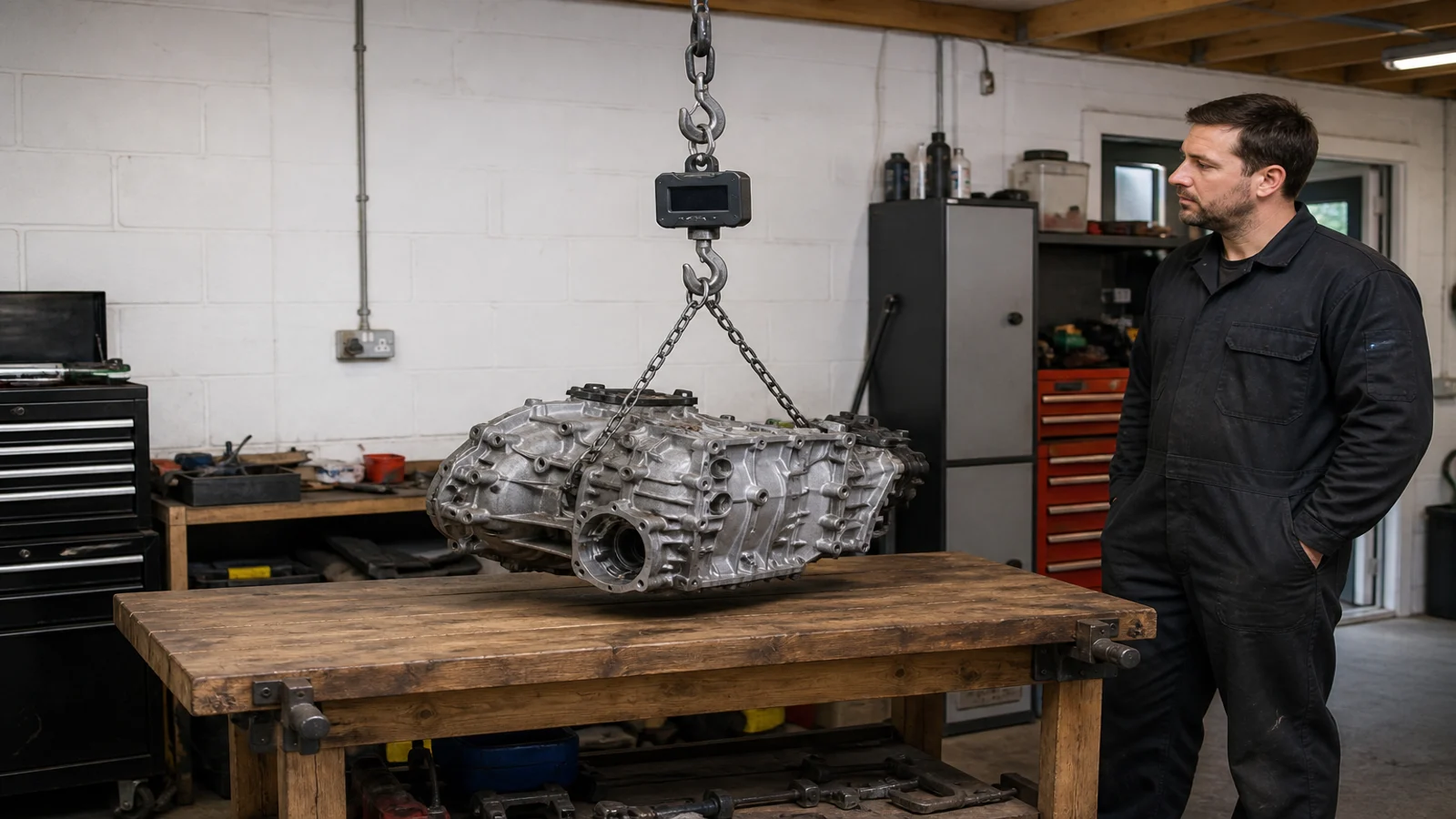
Weighing Engine Parts with a Hanging Scale: A Safer Garage Checklist
Weighing engine parts with a hanging scale is only sensible when a rated hoist or crane already carries the component, the attachment is meant for that job, and the part hangs a few centimetres above a bench, not over a person. The scale sits in the load path as an indicator. It does not become the hoist, and it does not invent a lifting eye on a smooth casting. If you would not lift the part without the scale, do not add the scale and try.
Is a hanging scale suitable for the engine part I need to weigh?
It can suit a compact gearbox, a head, or a similar lump that already has a manufacturer-identified lifting provision or a workshop-rated adapter, and that will hang true without dripping oil onto someone. It does not suit a loose pile of parts in a rag, a cracked bracket, or anything that would need a second person to stop rotation with their hands. Oily surfaces and missing thread in an eye are reasons to refuse the weigh.
How do I choose a lifting point without guessing?
Use the lifting provision named in the workshop information you actually have for that component, or a lifting accessory the hoist manufacturer allows. Do not pick a convenient hole because it looks strong. If the casting has no identified point, use a different method such as a platform with the part fully supported. Guessing an eye on an unfamiliar housing is how parts slip.
Work lifting equipment and lifting accessories require suitable planning, use and examination, as set out in the Lifting Operations and Lifting Equipment Regulations 1998 (LOLER). Planning includes knowing what you are hanging from.
What counts toward the gross suspended load?
Count the component, residual oil if you have not drained it, the adapter, chains, shackles, and the scale itself if it hangs in the same line. Compare that total with the lowest rating among hoist, accessory and indicator. Avoid hazardous manual handling where practicable and assess unavoidable handling tasks, following HSE manual handling at work. A hanging weigh is not a way to skip a drain that would make the part lighter and cleaner.
What sequence keeps the component controlled?
Use this checklist and keep the lift short.
- Drain what you can, bag loose fittings, and clear the bench.
- Run digital hanging scale safety checks on hook, sling and indicator.
- Confirm hoist travel, and that nobody stands in the drop zone, including under the bench gap.
- Attach only the identified lifting point. Take the slack slowly.
- Raise until the part is just clear, wait for stillness, read from the side.
- Lower onto wood or a stand before anyone approaches to unbolt anything else.
- If the part tilts, land it. Do not steady it with a hip.
HSE guidance on selecting, positioning, using and examining lifting equipment safely is in Lifting equipment at work: A brief guide. Position so a failed lift drops onto the bench, not into an aisle.
When should I use another weighing method?
Use a platform, a pallet with a known empty weight, or a specialist workshop when the part will not hang true, when oil would spray, or when you cannot identify an attachment. Shipping a long engine to another site is a logistics weigh, not a hook-and-hope over a pit. Do not hang a part over a vehicle interior to save rolling the car out.
If the hoist is already correct and you only need a 300kg-class indicator in the line, see the Soldestati 300kg digital crane scale after the pre-use checks pass.
Which signs mean stop and get competent help?
Stop if the lifting point is unidentified or the hoist rating is unknown. Stop if the part starts to tilt, slip or need a hand to steady it. Get help when the chain jumps, when a thread pulls, or when the load would pass over another person. Competent help means someone who owns the lifting equipment, not a second pair of hands in the drop zone.
Who this garage method is not for
This article is not for lifting a component over a person or a glass screen. This article is not for guessing a lifting eye on an unfamiliar casting. It is also the wrong method for a rope around a pulley, and for a pit with no exclusion while the hoist is in use.
When the job should stop
If the weigh requires bravery, it is already the wrong job. Land the part, keep the scale as a later option, and choose a supported method. Weight is useful for handling and transport planning; it is not worth a crushed bench or a swinging gearbox.
Oil, coolant and loose core plugs turn a clean weigh into a contamination job. Put a tray on the bench, and do not hang a wet part over a seat or a battery. If the adaptor needs a specific thread, chase that thread with the part on the stand, not in the air. Torque for a lifting eye is a workshop data item; if you do not have it, you do not have a lifting point.
Two-post and engine cranes have travel limits and swing. A scale in the line adds length. Check that the part will not hit the boom or a wing at the top of the short lift you actually need. If the only way to clear the bench is a high lift, redesign the stands instead. High hanging of a gearbox in a domestic garage is a stop, even if the number would be convenient for a listing.
When the figure is for postage, remember carriers use their own method. Your hanging number is for handling and for choosing a hoist, not for a guaranteed label. If a customer will collect, still land the part before they walk under it to look. Curiosity is not an exclusion zone.