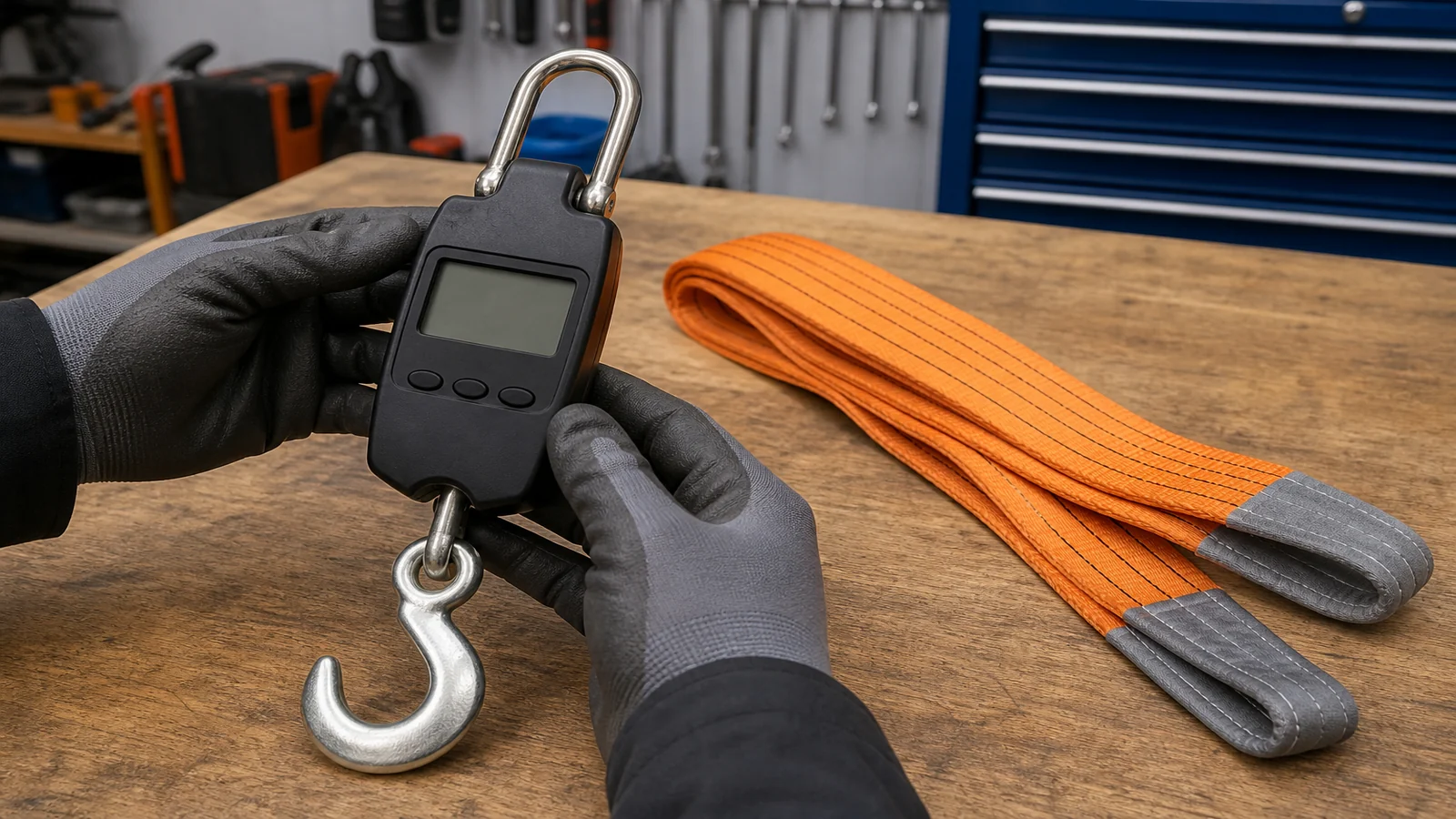
Digital Hanging Scale Safety Checks Before Every Weigh
Digital hanging scale safety checks are a short look at the instrument, the hook, the sling or shackle, the hanging point, and the floor before any load leaves the ground. A stable number on the display is not proof that the lifting arrangement is suitable. If a check fails, leave the load down. The scale indicates weight; it does not approve a beam, a hoist, or a home-made eye.
What should I inspect on the scale and hook?
Look at the housing for cracks, a loose battery cover, and a hook that opens fully and closes fully. Check that the latch or gate, if fitted, is present. Follow the sling around its full length for cuts, heat glaze, or crushed stitching. If the next step is unclear, put the kit aside rather than hoping a later weigh will be kinder.
Work lifting equipment and lifting accessories require suitable planning, use and examination, as described in the Lifting Operations and Lifting Equipment Regulations 1998 (LOLER). Your pre-use look does not replace that duty where it applies.
How do I check capacity before lifting?
Add the load, the sling, any container, and any extra hardware, then compare that gross figure with the lowest rating in the chain: scale, hook, sling, and hanging point. If you cannot estimate the load, do not lift it to find out. If the manual and the housing disagree, use the lower value. Capacity on a scale is not a licence to hang from an unrated shelf bracket.
What should I check around the work area?
Clear the drop zone. Keep walkways free. Check overhead for lights, doors and people who might walk through. Place the display where it can be read from outside the exclusion area. Avoid hazardous manual handling where practicable and assess unavoidable handling tasks, following HSE manual handling at work.
HSE guidance on selecting, positioning, using and examining lifting equipment safely is in Lifting equipment at work: A brief guide. Positioning includes not hanging a load over a desk where someone still sits.
Which faults make a reading unsafe or meaningless?
If the hook is not seated, then the reading can change when the load shifts and the next step is to lower it. If the sling is twisted, then the load can spin; the next step is to land it and re-rig. If the digits jump in a draught, then the figure is not a decision tool. If the battery warning is on, then stop before the display dies mid-lift. A hunting number is a control problem, not a maths problem.
Who needs a more formal examination regime?
Workplaces that use lifting equipment as part of the job typically need planned examination, competent people, and records beyond a personal checklist. DIY users still need intact kit and a controlled area, but they should not treat this page as a legal sign-off. If your insurer, landlord or employer already specifies an inspection interval, follow that written scheme.
Garage jobs that hang engine parts need the same pre-use discipline; see weighing engine parts with a hanging scale for that sequence. A compact indicator such as the Soldestati 300kg digital crane scale still depends on the hoist and attachments you already trust.
What means stop, isolate and seek competent advice?
Stop if the hook, shackle or sling is cracked, bent or incomplete. Stop if the hanging point or exclusion area cannot be controlled. Isolate the scale from the hanging point so nobody reuses a failed hook by habit. Seek competent advice when you cannot name the rating of the beam or hoist, when the load is unknown, or when a previous incident involved the same kit.
Who these pre-use checks are not for
This article is not for lifting people or animals. This article is not a substitute for a written examination scheme on work lifting equipment. It is also the wrong method for a scale with no readable capacity marking and no manual, and for a job that would place a load over a public footway.
When the job should stop
If any check is a guess, the weigh does not start. Put the load down, tag the kit, and come back with rated attachments. A missed weight is recoverable; a failed hook is not a paperwork issue.
Store the scale so the hook is not left loaded in a drawer under other tools. A bent gate often happens in the van, not on the job. After a drop onto concrete, retire the instrument from hanging use until someone who understands the model has looked at the load path. Dust in a farm shed can hide a hairline crack at the hook root; wipe before you inspect, then look again in decent light.
If several people share the kit, a tag that says last check and a spare sling in a sealed bag beat a verbal 'it was fine yesterday'. Do not share a stretched webbing sling across jobs of different lengths by knotting it shorter. Knots and twisted eyes are a stop. Keep chemical drums away from textile slings. Battery changes belong on the bench with the load down, never while a sack is in the air.
Think through the landing if the hook opened. Would the load hit a foot, a gas bottle, or a glass partition? If yes, the area check failed even if the steel looks shiny. Rehearse a lower-first rule out loud on training days so it is automatic when the display flickers. A pre-use check that only looks at the LCD is not a safety check.