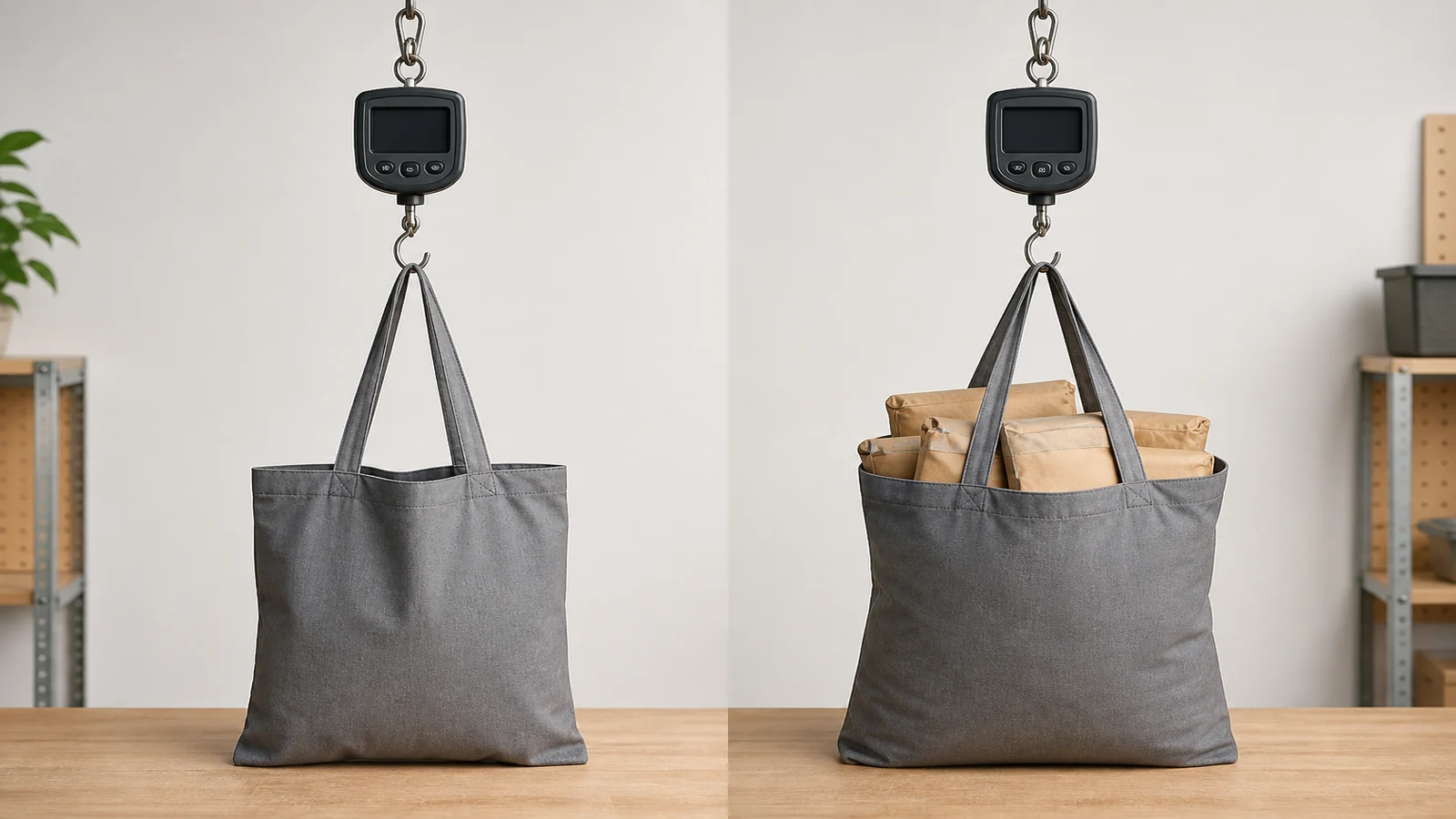
Tare vs Hold on a Hanging Scale: Which Button Solves Which Problem?
Tare vs hold on a hanging scale is a split between two jobs: tare subtracts a known empty container or sling from the live display, while hold freezes a figure after the load has already settled. They are not interchangeable. Hold does not make a swinging load true, and tare does not raise the maximum gross weight the hook may carry. Button labels vary by model, so the manual always wins over this page.
What is the practical difference between tare and hold?
Tare is for the empty bag, crate or webbing you do not want in the net figure. You hang that empty item, wait until it is still, then tare, then add goods. Hold is for a display you cannot watch continuously once the digits have stopped, for example when you must step aside to write. If the load is still moving, neither button is the right first action.
| Problem | Better function | Why |
|---|---|---|
| Reusable tote weight in the reading | Tare | Removes a known empty mass from the display |
| Need to copy a settled number while standing clear | Hold | Freezes digits after motion has stopped |
| Load still swinging | Neither | Fix the rig first |
| Want more capacity | Neither | Gross load still counts |
When should I tare a container or sling?
Tare when the empty sling or tote will stay on the hook for every weigh in that batch, and when you can hang that empty item safely. Re-tare after you swap bags, after the sling gets wet, and after anyone unhooks the scale. If you tare a heavy crate and then hang a lighter bag, the live figure is fiction. Record whether the sheet shows net or gross so the next shift does not double-subtract.
Warehouse tote work often depends on this habit; the warehouse parcel weighing checklist puts tare at the start of the station sequence.
When is hold useful?
Hold is useful when the load is already still, the digits have stopped, and you need a few seconds away from the display. It is also useful in bright sun where you glance, step aside, then write. It is not a way to average a hunting number. If your model uses a different word such as lock or peak, follow that manual rather than assuming hold behaviour.
Does hold make a reading more accurate?
No. Hold stores whatever the instrument last decided. If the load was oscillating, hold stores a snapshot of that oscillation. Accuracy comes from a still load, a seated hook, and a scale used inside its indication range. Hold is a reading aid, not a calibration step.
Does tare increase the scale's capacity?
No. Tare only changes what the display shows. The hook, sling and hanging point still carry the empty container plus the goods. If that gross total is too high, remove goods or use a higher-rated system. Taring a 20 kg crate does not create 20 kg of extra allowance on a 300 kg indicator.
HSE guidance on selecting, positioning, using and examining lifting equipment safely remains the frame for the physical setup, not the buttons, in Lifting equipment at work: A brief guide.
When should I fix the setup instead of pressing either button?
Fix the setup when the load spins, the wrap catches the floor, the hook is not closed, the hanging point moves, or people would need to stand under the load to see the screen. Buttons cannot correct a twisted sling. Move the display, shorten the drop, or change to a platform. If you find yourself tapping hold repeatedly to chase digits, the station is wrong.
When the empty tote hangs cleanly and you only need a compact indicator, the Soldestati 300kg digital crane scale is a possible fit after you have confirmed gross capacity and a safe hanging point.
Who this button guide is not for
This article is not for models whose buttons do something else than the labels suggest. This article is not for using tare to hide an overload. It is also the wrong guide for peak-hold of a shock load, and for anyone who cannot hang the empty container without standing in the drop zone.
If the manual and the printed icons disagree, stop and identify the actual functions before the next live weigh. A wrong tare at the start of a shift can follow every parcel until someone notices the sheet looks light. A held figure copied from a swinging sack can follow that sack onto a van. Treat buttons as last, after the load is still and the hook is seated, not as a way to finish faster than the station allows.
Write the function you used on the record: net after tote tare, or a held gross. That sentence prevents the next person from taring again on an already netted bag. If two operators share one scale, agree the rule in one line on the wall rather than arguing over memory. When a guest worker arrives, show the empty tote hang before any goods go on the hook. The cheapest error to prevent is the one where everyone believes the display while the crate is still in the number.
Night work and gloves change how people use buttons. A bulky glove can press tare and hold together, or hold a key long enough to enter a setup menu. If the display suddenly shows a unit you do not use, land the load and recover from the manual rather than guessing. Keep a printed one-page map of the actual keys for that serial, not a generic photo from another brand.
Peak or animal-weigh modes on some instruments are not the same as hold. Peak captures a maximum during motion, which is the opposite of a still hanging weigh. If your unit has a peak key, cover or disable it for dispatch work. Likewise, a count function that wants a sample piece is irrelevant to a tote of mixed parcels and will only confuse the sheet.
When two sheets disagree, ask whether one is net of tote and one is gross. That argument is cheaper than buying another scale. Photograph the empty tote on the hook during induction so new staff see what tare is supposed to look like. If the empty hang is not allowed because the beam is busy, you do not have a tare process yet, only a hope. Build a spare hook or move to a platform until the empty hang is routine.
Outdoor markets add wind. Hold will freeze a gust as easily as a true still point. Tare a crate on a gusty corner and the net of later goods inherits that error. Move the station into shelter, or accept that hanging indication is the wrong tool for that pitch. Buttons are not a windbreak.