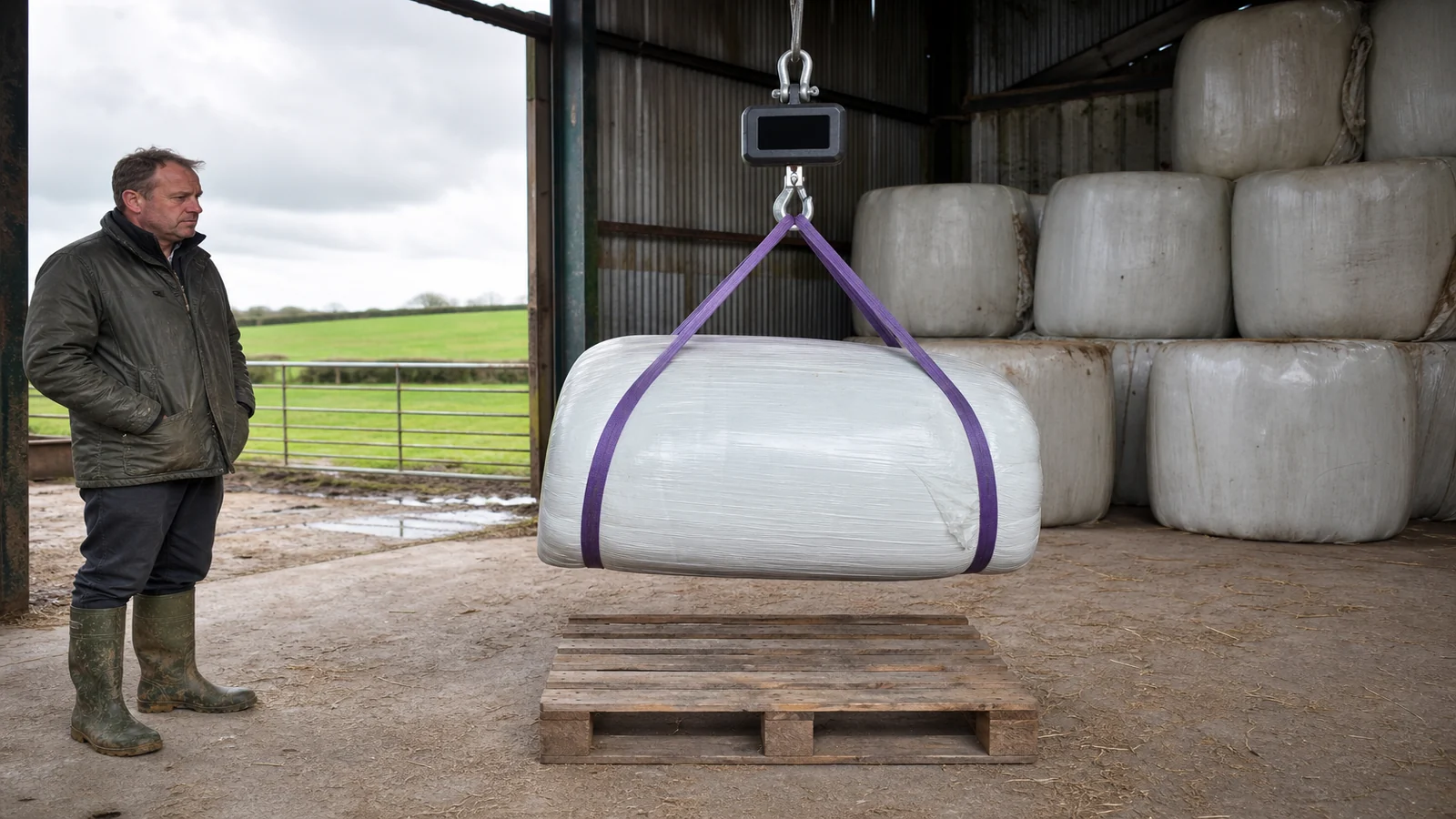
Hanging Scale for Hay Bales UK: A Practical Smallholding Setup
A hanging scale for hay bales UK smallholdings can work when the bale is wrapped or netted, the expected weight sits well below the scale and attachment ratings, and the lift is only high enough to clear the ground. It is a weighing aid, not a farm crane. Keep people out of the drop zone, and treat wind, torn wrap or a swinging load as a reason to lower the bale rather than chase a number.
Will a hanging scale suit the type and expected weight of my hay bales?
It suits compact, reasonably regular bales that can be slung without crushing the wrap, with a known lifting point such as a pallet fork, a rated beam, or a loader already used for that bale size. Round bales that roll, broken strings, and wet bales that have sat in a ditch are a poor match because the centre of gravity moves and the wrap can tear.
Estimate from similar bales you already move, not from a catalogue average. Add the sling, pallet or net. If you cannot name a plausible upper weight, do not hang it. Work lifting equipment and lifting accessories require suitable planning, use and examination, as set out in the Lifting Operations and Lifting Equipment Regulations 1998 (LOLER).
How much capacity margin should I leave?
Leave spare capacity for the heaviest plausible bale in that stack, plus attachments, plus a little movement. Do not treat a round number on the housing as a target to fill. If two bale sizes share one scale, size the system for the heavier family. If the scale and the loader disagree about rating, the lower figure wins.
HSE guidance on selecting, positioning, using and examining lifting equipment safely is in Lifting equipment at work: A brief guide. Follow the scale manual for indication limits. The scale does not upgrade a worn strap.
What is a sensible step-by-step weighing routine?
Use this checklist and keep the bale close to the ground.
- Clear the drop zone. Nobody stands under or beside the load path.
- Inspect wrap, strings, sling, shackles and hook. Replace damaged kit before any lift.
- Confirm the hanging point is intended for that load, not a random rafter.
- Zero the scale with the sling attached if the manual allows a tare for the empty sling.
- Attach the bale, lift only until it is free of the pallet or floor, then wait until the display settles.
- Record the reading, the bale identity, and the weather if you are outdoors.
- Lower immediately. Do not walk under the bale to read a poorly placed display.
Avoid hazardous manual handling where practicable and assess unavoidable handling tasks, following HSE manual handling at work. Do not roll a bale by hand to chase a better angle once it is already on a loader.
What makes the reading unreliable?
Wind on a big face, a load that still swings, a wrap catching the floor, a battery warning, and a hook that is not fully seated all wreck a reading. Moisture after rain changes weight from one morning to the next, so treat the figure as a farm record, not a lab certificate. If the digits jump after you thought the bale was still, lower it and start again rather than averaging in your head.
When should I use a platform or professional setup instead?
Use a platform, weighbridge, or a contractor with suitable lifting plant when the bale is too large for your attachments, when you need a trade weight, or when you cannot keep the lift low and controlled. A hanging scale is the wrong tool for a stack that would require people to guide a swinging load with their hands.
If you still need a compact digital indicator for smaller farm loads, see the Soldestati 300kg digital crane scale only after the lifting arrangement itself is sound. Pair that with digital hanging scale safety checks before the first bale of the day.
What conditions mean I should stop immediately?
Stop if anyone would need to stand under the bale. Stop if the sling, hook or wrapping looks damaged or the load will not sit still. Stop in gusty wind, if the wrapping starts to tear, or if the hanging point creaks or shifts. Lower the load first, then talk. Do not hold a spinning bale with your body.
Who this hay-bale method is not for
This article is not for anyone who would stand under a suspended bale. This article is not for selling hay by weight as a legal-for-trade transaction. It is also the wrong method for a hired yard where you do not control the lifting plant, and for bales that cannot be slung without cutting the wrap open.
When the job should stop
If the only way to see the display is to step into the drop zone, move the scale or use a different method. Farm records are useful; an unsafe lift is not. Keep the bale low, the people clear, and the number as a check against guesswork rather than a reason to improvise taller lifts.