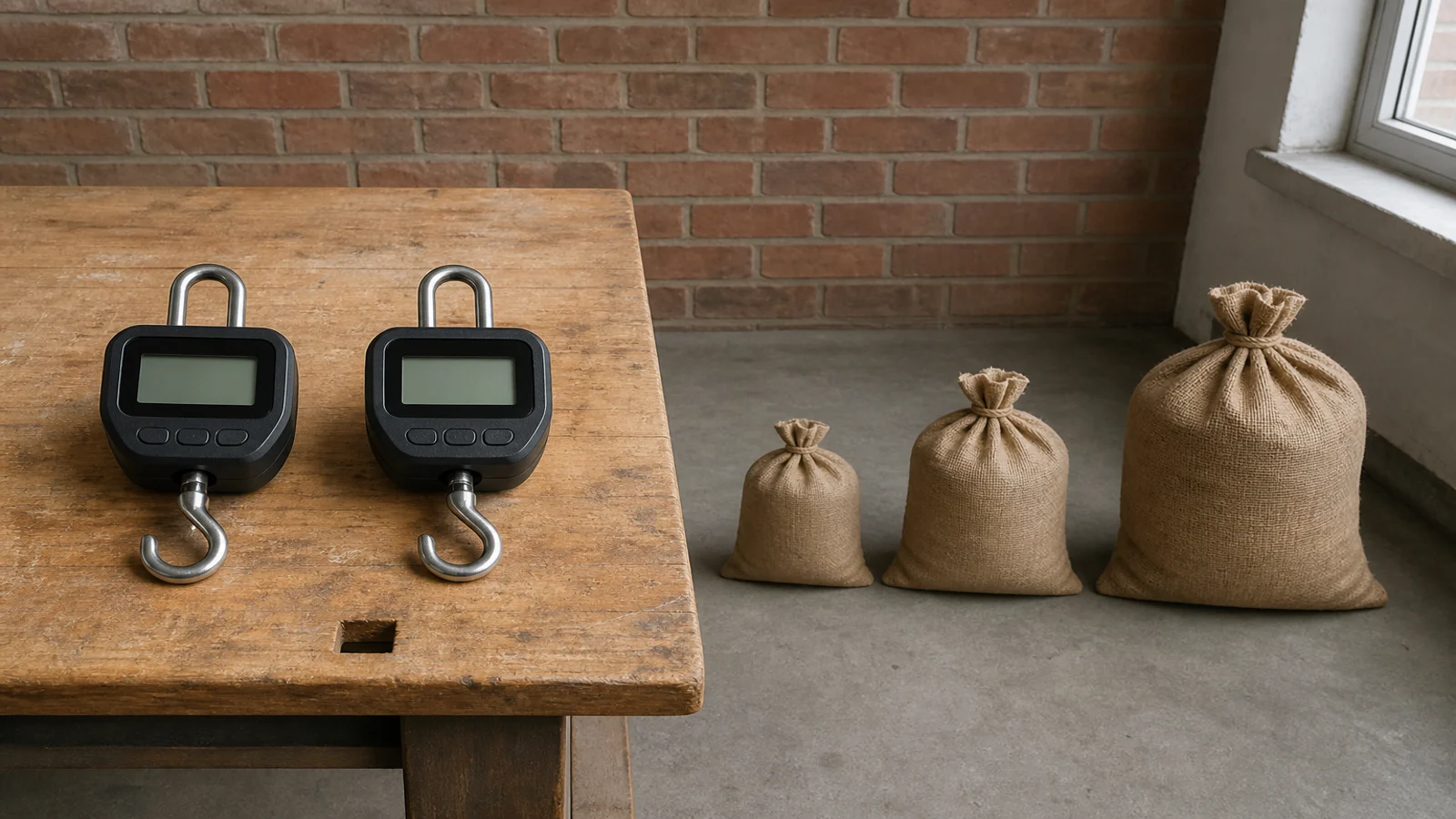
300kg vs 500kg Hanging Scale: Choose Capacity Without Guesswork
A 300kg vs 500kg hanging scale decision starts from the heaviest thing you will hang, plus sling, crate and hardware, not from a round number that sounds future-proof. Capacity on the indicator is only one rating in a chain. If the hoist, beam or strap is the weak link, neither 300kg nor 500kg on a scale housing fixes that. This page does not assign accuracy or increment size to a 500kg class.
Should I choose 300kg or 500kg for my heaviest load?
Choose 300kg when the heaviest realistic gross load, attachments included, stays comfortably inside that indication range and your lifting arrangement is already rated for it. Look at 500kg class instruments only when the same honest gross total would crowd or exceed 300kg. If you cannot name the heaviest job, you are not ready to pick either figure. Farm examples such as a hanging scale for hay bales UK still follow the same gross-load logic.
| Heaviest honest gross load | Direction | Watch-out |
|---|---|---|
| Well inside 300kg after sling and crate | 300kg class indicator | Do not fill the last few kilograms for fun |
| Crowds 300kg on busy days | Consider a higher-capacity instrument | The hoist must match |
| Unknown or wildly variable | Neither yet | Measure or refuse the job |
Why must container, sling and attachment weight count?
The hook carries everything below the hanging point. A wet sling, a steel crate, and a shackle are not free. Tare only hides them on the display. If you ignore them, a 280kg payload plus 40kg of kit is already a different job. Weigh or estimate the empty rig on a quiet day and write it on the station card.
How much spare capacity is sensible?
Leave room for a heavier-than-usual item in the same family, for water after rain, and for the fact that people underestimate awkward shapes. There is no universal percentage that makes a lift safe. If your work is always the same bag of feed, a modest gap above that bag plus kit can be enough. If your work is whatever arrives on a trailer, you need a larger gap or a different method.
What trade-offs matter besides maximum capacity?
Readability at the distance you will stand, battery life, hook style, and whether you can mount the display outside the drop zone often matter more than a higher ceiling you will never use. A heavier-duty instrument can be bulkier to carry between sites. Portability is wasted if you then hang it from an unrated nail. HSE guidance on selecting, positioning, using and examining lifting equipment safely is in Lifting equipment at work: A brief guide.
When is a lower-capacity scale the better fit?
A 300kg class tool is the better fit when it covers the real jobs, stays readable, and matches the hoist you already inspect. Buying headroom you cannot hang safely encourages overloaded straps. Small warehouse totes and many workshop parts never need a 500kg story. Match the instrument to the work, then keep the work inside that match.
If 300kg with spare room is the honest fit, the Soldestati 300kg digital crane scale is the on-site example of that class, not a claim about 500kg products.
When are neither 300kg nor 500kg appropriate?
Neither is appropriate when the hanging point is unknown, when people would stand under the load, when you need legal-for-trade selling by weight, or when the load should never leave a platform. Work lifting equipment and lifting accessories require suitable planning, use and examination, as set out in the Lifting Operations and Lifting Equipment Regulations 1998 (LOLER). A bigger number on a scale does not complete that planning.
Who this capacity comparison is not for
This article is not for buyers who need a stated 500kg resolution or accuracy figure. This article is not for treating scale capacity as proof the hoist is adequate. It is also the wrong comparison for continuous process weighing and for loads that would need a crane company rather than a portable hook scale.
When the job should stop
Stop if the hanging point or sling rating is unknown. Stop if the heaviest gross load cannot be estimated before purchase. Put the catalogue down until those two facts exist. Capacity shopping without a rated lift is just a heavier accident waiting for a number.
Dealers sometimes talk about future-proofing. Future-proofing that depends on an unrated beam is fiction. Write the heaviest job you did in the last quarter, add kit, and only then look at 300kg versus a higher class. If last quarter's heaviest job was a 40kg sack, a 500kg story is probably marketing, not engineering. If last quarter included a wet round bale you should not have hung, the answer is a different lift, not a bigger indicator.
Resolution, temperature, and how the instrument behaves near the top of its range are model-specific. This comparison does not assign those figures to a 500kg class. Ask the supplier for the datasheet of the exact unit, then still check the hoist. A finer increment on a higher-capacity instrument can look attractive on a spreadsheet and still be the wrong physical tool if you cannot read it from outside the drop zone.
Shared kit across farm and warehouse tempts people to buy the larger number once. That only works if every site has a hanging point rated for the new ceiling and staff who will not fill it. Otherwise you train two bad habits: hanging too much on the farm, and hanging rigid cartons in the warehouse because the scale 'can take it'. Split the processes. Keep a 300kg-class indicator where 300kg is honest, and send oversized jobs to a platform or a contractor.
Insurance questionnaires sometimes ask about lifting equipment. Answer with the hoist and accessories you actually examine, not with the scale's printed capacity. Mixing those answers is how a weighing aid gets described as something it is not. Keep purchase notes that separate indication range from lifting ratings so a later audit does not blur them.
Hire shops sometimes stock several classes. Hiring a higher class for one weekend still requires the same hanging-point check as a purchase. Returning a 500kg-class tool does not undo a bent strap you used at home. If the hire paperwork lists examination dates for the hoist, read those; the hanging indicator is extra, not a substitute. If there is no hoist paperwork because you planned to hang from a domestic joist, refuse the hire.
Temperature swings between a cold barn and a warm van can change how you read a display, but they do not change the need for spare capacity. Do not compensate for a faint LCD by standing closer under the load. Move the work, add light, or pick an instrument you can read from the side. Those practical trade-offs belong in the buying decision alongside 300kg versus a higher class.